Why the Same Show Hits Completely Different When You Watch It With Other People
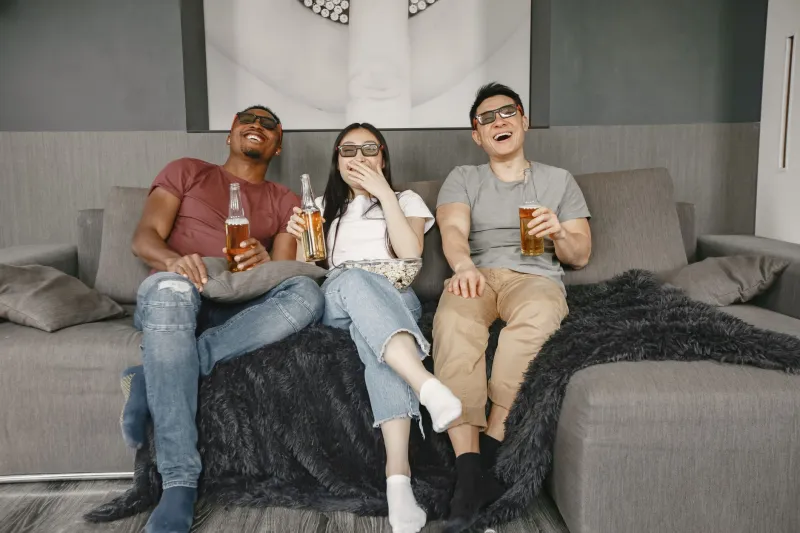
Ask anyone who's ever watched a horror movie alone versus with a group of friends, and they'll tell you immediately: it's not the same movie. The jump scares land harder in a crowd. The comedy is funnier. The tear-jerking moment in the finale hits like a truck when you can hear someone else sniffling next to you.
This isn't imagination. The experience genuinely is different — and the reasons why go deeper than just the comfort of company.
Your Brain on Social Viewing
Neuroscientists have a term for what happens when brains sync up during shared experiences: neural coupling. When two people experience the same story simultaneously, their neural activity starts to mirror each other in measurable ways. A 2021 study from Princeton found that viewers watching the same film together showed significantly higher degrees of brain synchrony than those watching separately — and that higher synchrony correlated directly with stronger emotional responses and better retention of the content.
In other words, your nervous system is literally more engaged when someone else is engaged alongside you.
Social psychologist Sherry Hamber, who studies group emotion at UCLA, describes it as "emotional amplification through social mirroring." When you see someone react to something — laugh, gasp, go quiet — your brain doesn't just register their reaction. It recalibrates your own. Their response becomes part of the input. You're not just watching the screen anymore. You're watching the screen through the collective lens of the room.
The BongdaLu Effect in Practice
We asked members of the BongdaLu Network community about specific moments where group watching changed how they felt about something. The responses were striking in their consistency.
Jordan, a 26-year-old from Austin, described rewatching Interstellar during a community watch party after having seen it twice already at home. "I thought I knew exactly how I felt about that movie," she said. "But when the docking scene came on and the chat just exploded and I could hear people in the voice channel holding their breath — I got chills I'd never gotten the first two times. It was like experiencing it for the first time again."
Marcus, a 31-year-old from Chicago, had a similar story about a gaming stream. "We were all watching a blind playthrough of The Last of Us together. I'd played it. I knew what was coming. And I still cried at the ending because everyone else was losing it and that just — it got me. Knowing how it lands, being there when it lands for someone else, it's a completely different thing."
These aren't edge cases. They're consistent with what researchers call the social facilitation of emotion — the tendency for emotional experiences to intensify in the presence of others having the same experience.
Why This Matters More Than You Think
Beyond the individual viewing experience, there are real mental health implications to this phenomenon. Dr. Robin Dunbar, the British anthropologist famous for "Dunbar's Number," has written extensively on how shared laughter and shared emotional experiences trigger endorphin release — the same neurochemical system activated by physical touch and exercise. Watching something funny with people who are also laughing produces a measurably different physiological response than laughing alone.
In a period when US adults are reporting record levels of social isolation — the Surgeon General's 2023 advisory on the loneliness epidemic made headlines for a reason — this has genuine significance. Group entertainment isn't just fun. It's a form of social bonding that our bodies are literally wired to respond to.
The flip side is also true. Solo consumption, even of content we love, tends to produce shallower emotional imprints. We enjoy it in the moment, but the experience doesn't stick the same way. The memories we form in social contexts are more vivid, more emotionally detailed, and more durable over time.
The Community Angle Nobody's Talking About
Platforms built around shared experience — watch parties, co-streams, synchronized community viewings — aren't just a feature. They're fundamentally changing the relationship between content and audience.
When you watch something in community, you're not just consuming a piece of content. You're creating a shared reference point. An inside moment. A story that belongs to the group. "Remember when we all watched that finale together and everyone went silent for like thirty seconds" is a memory that lives in the community, not just in individual minds.
This is why community-driven platforms are increasingly where the most passionate, loyal fanbases live. The content is the starting gun, but the shared experience is what people actually come back for.
BongdaLu Network users consistently describe the watch party format as something closer to an event than a viewing session. There's anticipation. There's real-time reaction. There's the post-watch conversation that can go on longer than the content itself. That's not passive consumption — that's participation.
Designing for Connection
What this research points toward is a design principle that entertainment platforms are slowly starting to catch up with: the vessel matters as much as the content inside it. A great show watched in isolation is a private experience. The same show, watched with a group who's invested in it, becomes something closer to a cultural event.
The gaming world figured this out early. Games designed around shared experience — whether that's cooperative play, spectator modes, or community tournaments — generate deeper loyalty and stronger emotional attachment than solo games of equivalent quality. The same principle applies to film, TV, and every other format.
If you've been watching alone and wondering why nothing seems to stick the way it used to, this might be the answer. The content hasn't gotten worse. You've just been watching it in the wrong room.